RMSE at 72 hours
High-resolution global weather forecasting
Pushing the Limits of High-Resolution Weather Forecasting through Data Scaling
Transfer data, not models. BaguanHR scales native 0.1° forecasting by turning long coarse-resolution reanalyses into high-fidelity training data.
Nanjing University · Ant Group · Alibaba Group
0.1°native global forecast grid
>85%lead times improved within 72 h
18 yearssynthetic-plus-real training data
The core shift
High-resolution forecasting is a data-scaling problem.
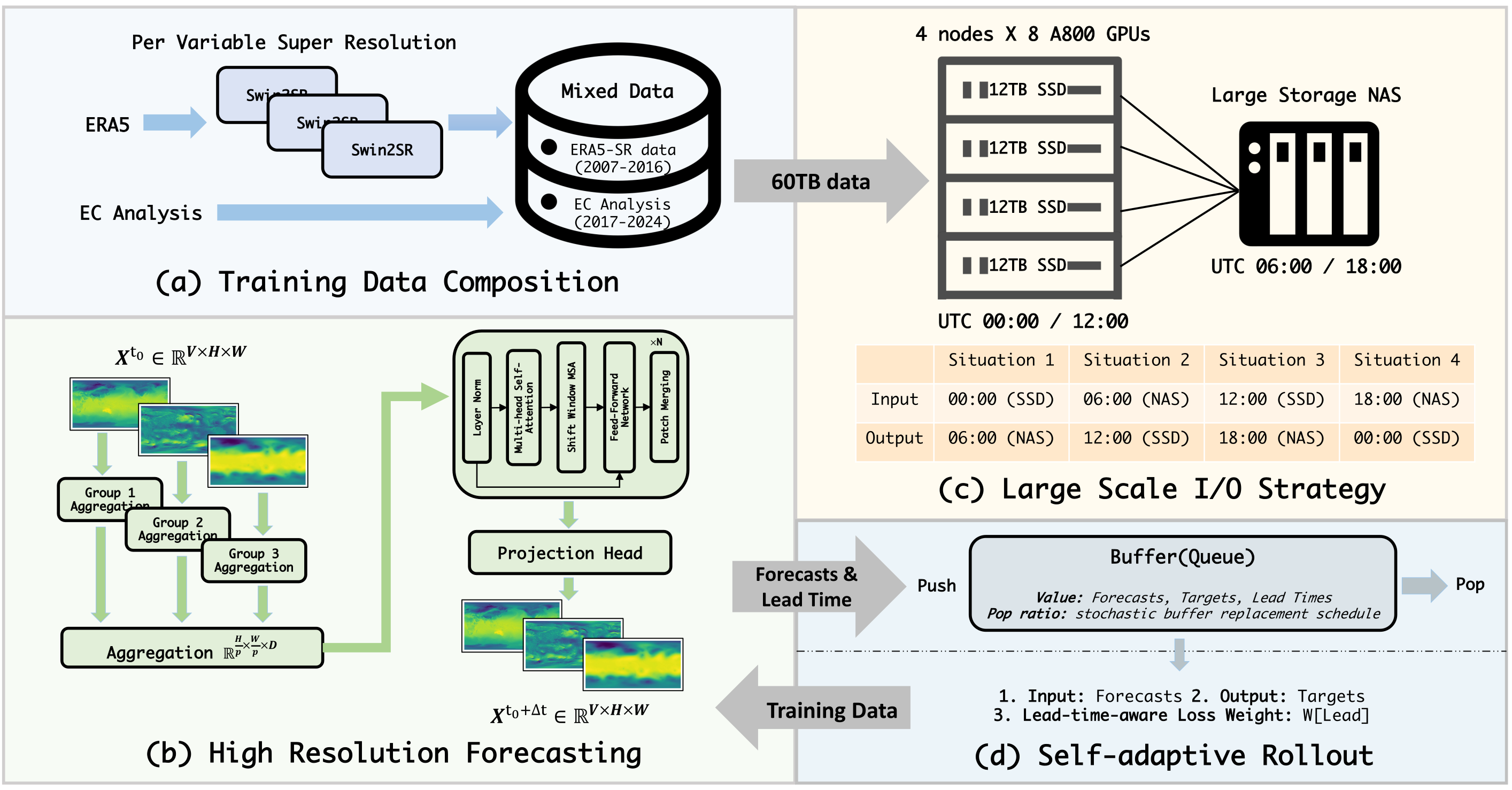
Super-resolution is a same-time reconstruction task with lower conditional entropy and error amplification than multi-step forecasting. We use that stability to construct the data a native high-resolution model needs.
Method
Transfer data, not models.
Variable-wise SR expands the short 0.1° analysis archive with a decade of high-fidelity pseudo-labels from ERA5. A native 0.1° model then learns directly from the combined synthetic-plus-real dataset.
- Per-variable super-resolution preserves field-specific texture.
- Native high-resolution training avoids coarse-grid information loss.
- Lead-time-aware replay stabilizes autoregressive rollout.
Scaling law
More high-resolution data consistently lowers forecast error.
Error follows a power-law-like trend as the training archive grows, revealing a predictable return from scaling data rather than only scaling model complexity.
RMSE at 120 hours
before gains become increasingly sub-linear
Main results
Native 0.1° forecasting wins where it matters most.
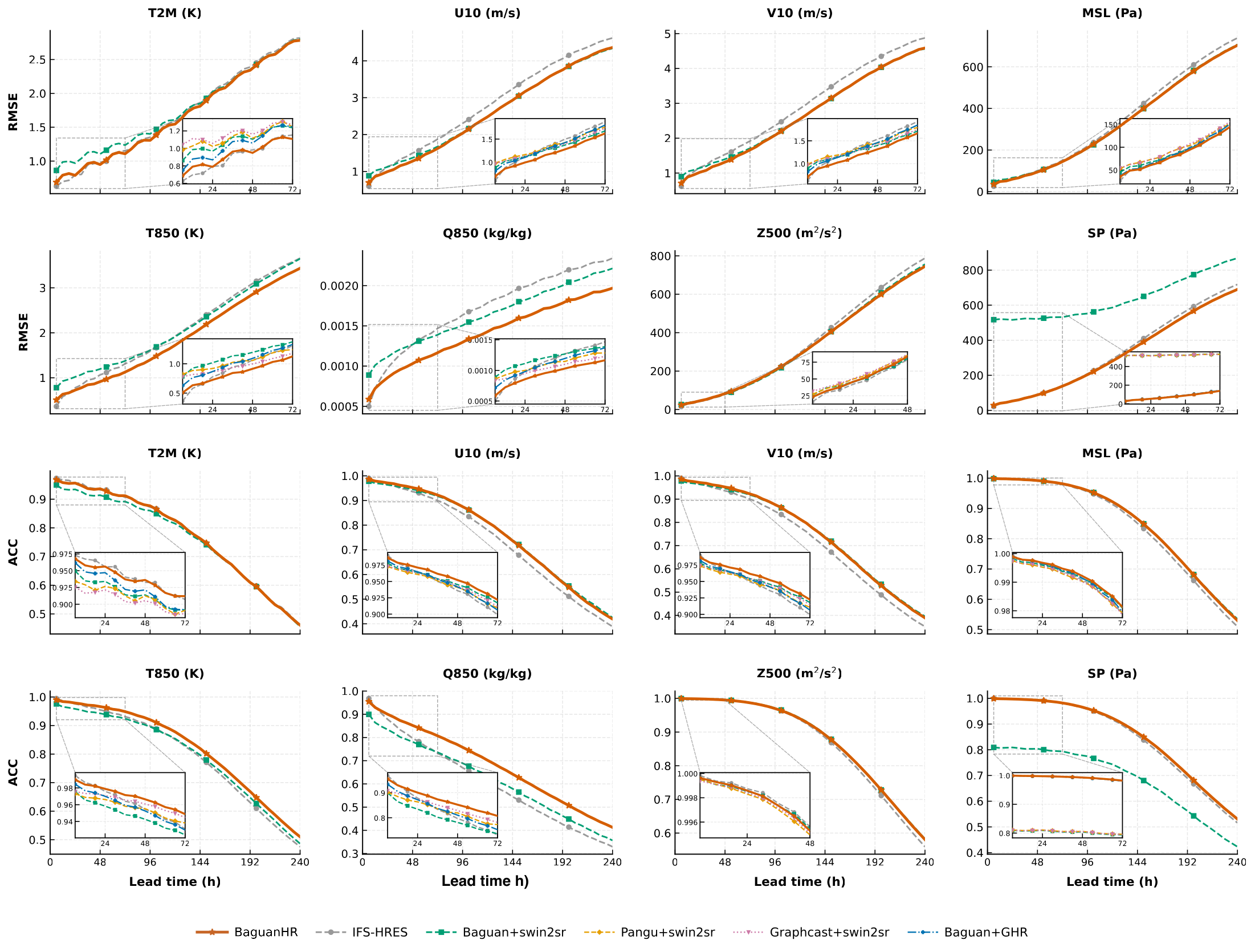
BaguanHR outperforms physics-based and ML baselines at more than 85% of evaluated lead times within 72 hours, with 5.8% lower average RMSE at 24 hours and 9.7% lower at 72 hours than IFS-HRES.
Extreme-weather case studies
Fine-scale detail survives the forecast.
Typhoon CO-MAY
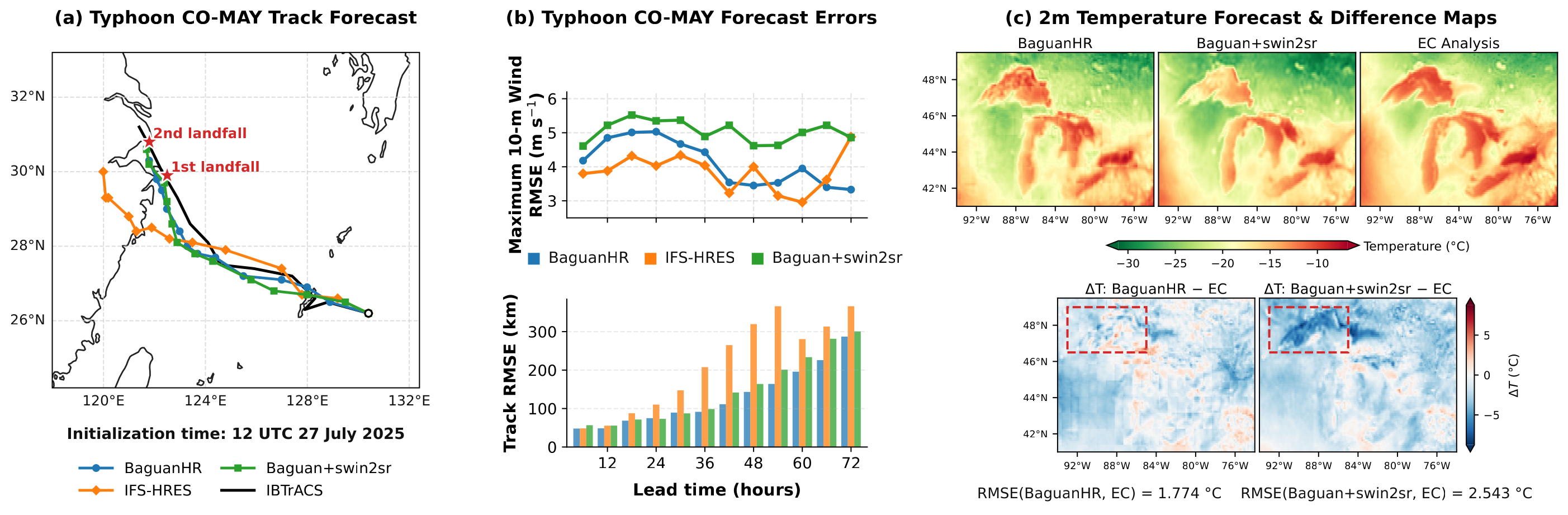
BaguanHR captures both landfalls, outperforming IFS-HRES in track accuracy and Baguan+Swin2SR in both track and intensity.
Great Lakes cold-air outbreak
BaguanHR resolves lake-land temperature contrasts missed by post-hoc SR, reducing t2m RMSE from 2.543 °C to 1.774 °C.
Summary
High-resolution forecasting is primarily a data-scaling problem.
Transfer data. SR unlocks decades of coarse reanalysis for native 0.1° training.
Scale data. Doubling the archive reduces RMSE at both 72 and 120 hours.
Forecast natively. BaguanHR preserves mesoscale detail that post-hoc SR smooths away.
BibTeX
@inproceedings{zhao2026baguanhr,
  title={Pushing the Limits of High-Resolution Weather
    Forecasting through Data Scaling},
  author={Zhao, Yang and Niu, Peisong and Zhou, Tian and
    Ma, Ziqing and Ma, Guanlong and Jin, Rong and
    Yuan, Huiling and Sun, Liang},
  year={2026}
}